

For Its Own Sake
Professional creators who do not see the intrinsic value of their art end up destroying their own market.

Hi, and welcome back to Past & Future!
Today we will go back to everyone’s favorite scandal: the Epstein letters! Relax, you are reading no crime reporting here; there was, instead, a single, less shocking exchange that gave me the inspiration for this post. A gaming related one!
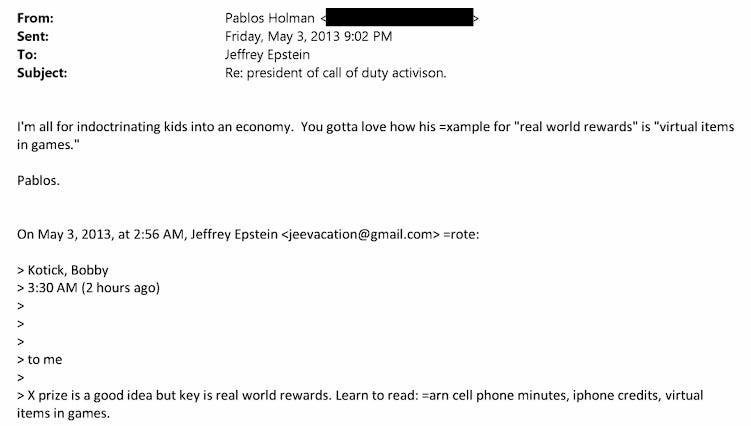
This is no outrage journalism applied to the videogame industry, either. When I stumbled on this exchange on X, the cultural background1 behind these ideas made me chuckle a little bit. Several accounts focused on Epstein’s possible role in pushing a larger implementation of micro-transaction in the gaming market through Kotick, but, whether this is actually true or not, nobody stopped to analyze the vision of entertainment that these people reveal.
The cultural context behind the exchange is that entertainment has no value in itself, or, at the very least, games have no value as games but only acquire weight as one among many gears in the economy machine. The real scandal here is this: what is being discussed is how to impose on the public the mindset of investors/publishers that can only see in games the monetary value they produce.2 Here, playing can only have value thanks to these “real prizes”; hence, entertainment in itself is a waste of resources, and the industry’s job is to give it value by applying material gain on it. Would you look at that! Play has just become work.
The ideas expressed in this e-mail are unfortunately largely shared by the people that work in the related industry. What I want to focus on is not this single exchange, but the fact that the craftsmen of a complex creative industry tend to share the same cultural foundation that an unscrupulous financier3 has.
We complain all the time about the loss of creativity in big productions, whether we are talking about videogames, or movies, or anything else. Once you deeply look into smaller productions, you discover that they suffer of the same illness, too. How many indie developers all conform to the same few habits? More than you believe. And again, this can be said for every medium.
A lot can be said about this cultural loss: political climate, economic pressure, loss of socio-cultural cohesion and so on. But what about the craftsmen’s philosophy?
I will never get tired to stress that I do not belittle the importance of money. Making money is a human need, and it is good when done in the right way. But all jobs require a certain philosophy guiding them; you have to make money in the right way. A very simple example: you cannot make money by breaking the law. It can be uncomfortable to have to follow a set behavior or practice, but nonetheless straying from the correct path will only make things worse, in the end.
If you make art, of any kind, even the lowest-grade one you can think of, even if it sucks, you need to follow a set code. Your job does not consist in just responding to emails during work-hours. It is to connect with the people, to capture their minds and souls.
At this point professional artists look at their creations only through the lens of monetary gain. They cannot conceive of making money by providing a set artistic experience: only their wallet matters. This attitude reflects not only the creative poverty of modern productions, but it also shows why creatives do not even talk about their work as creative work anymore. Only as a service rendered, as if art was insurance. The only exception is when AI is brought up, but we all know that their only problem is losing their own job, nothing more, nothing less. Everyone is on-board with AI if they keep getting that paycheck.

In the case of gaming, in particular, this twisted cultural foundation ruins the essence of what “play” or “game” mean.4 In itself, playing a game is not centered about concrete gain.5
This attitude has ultimately destroyed the film industry, ensuring that only a handful of movies in one year are able to reach the audience (while still remaining niche, in most cases). The irony is that now making a profit is more of an aspiration rather than the expected outcome. Even though the industry may still survive for much time, at some point private and public investors will close the valve and money will stop flowing into a sector whose impact is nonexistent. Literary publishers are stuck in the same conditions: eventually, “pornography but for women” will stop ensuring the industry’s survival. It is unsustainable and predatory: such behavior will make a profit at the start only to leave a burned wasteland later.
Professional creators must make peace with the double face of their job. As much as it is important to be able to make money, the work itself must have an intrinsic value regardless of profitability. Ignore this necessity at the expense of your own market.
Trying to force such a materialistic view of artistic creation on the customers themselves will not be a solution, either. There are specific reasons why people seek entertainment of any kind, and it is weird that professionals, who proud themselves of their higher expertise, fail to see them.
I am sure you are aware that, when you enjoy a work of art, you tend to exclude everything else going on in your life. You forget your own problems and issues. It is, usually, the very reason why you choose to spend your free time in such a way. People keep their interest and attention levels according to their own personality and needs, but this remains a staple of the artistic experience. The world has to stop existing to enjoy art.
It is also why sometimes, as an adult, you might choice to just do nothing instead of, say, watching a movie: for several reasons you cannot fully focus on the art, you cannot push the world out of the borders set around yourself and the screen. Without these borders, the movie is just white noise.
This apparently obvious reality has even been studied by several scholars of human behavior. Coincidentally, it is one of the first things that anthropology has studied about the subject of games and play. Johan Huizinga6 came out with the concept of the magic circle, a closed space (real or virtual), isolated from the rest of the world, where the game can take place and its rules can be properly applied. Those who enter the magic circle may not exist at the same time in the world outside, and the latter has only two ways to get you out: it can either pull you out “violently”, or it must wait for the game to end. Out of the magic circle, the game might remain as a concrete artifact but the activity of playing it ceases.
Do you understand where I am pointing at? Games cannot be tied to monetary concepts that apply to the real world, and the same can be said for all entertainment. You cannot impose the outside world on the magic circle, or else, the game stops being a game and it is just a job!
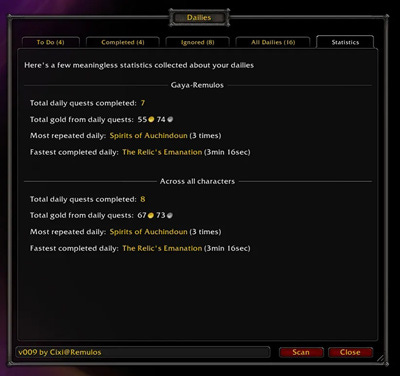
Is it not, in a more limited sense, what the industry has done with the introduction of daily missions and goals?
The prospect of getting “real world rewards” will attract a certain set of consumers, this is true. Once the production team has implemented them, it believes to have got a success when it sees an initial surge of profits and, especially, engagement. Such a set of consumers, though, is limited and exclusive: as in all things, you can only get so many people on board, and though they may seem at the start a large mass, at the same time the rest of your public will start walking out. This other crowd has a job already, and, if these people wanted a second one, they would apply to an actually profitable job. They play games because of the beneficial effect of entering the magic circle, not to get phone credits, and they will leave once the game is not fun anymore. They might do it slowly because of several reasons, but they will.
As I said, such a concept can be applied to games as well as to every other type of entertainment. You enter the magic circle when you read a novel, unless you have to do it as part of your job or your studies (and this is why reading as a reader is different than reading as an editor or as an academic). The same goes for film. Art has an impact on you because its enjoyment is detached from everyday life.
You cannot impose a materialistic view on the public if what you do is creative work. The best outcome you get from such an operation is to change its composition, but in the end you are not improving on the profits as much as you think. You might think that this second public that you got will easily spend more money, but they are as easy to leave you once someone else offers them more valuable rewards. This works for fandom, as well: the initial high of attachment and identity will soon wear off, the trend will pass, and your obsessed fans will forget you and move on.
Artists, remember that art has a value in itself, and that value is the only reason why people enjoy it. They do not pay you out of duty or charity, but because you are able to give them that intrinsic, immaterial value, and they want you to keep doing it.
It remains to talk about the bad relationship that professionals have with the concept of making art for money. Since the core idea of this post has been expressed already, we will leave this topic for another post later in the year. For the time being...
Thanks for reading!
Until next time.
Or better, the lack of it.
“Epstein was a gamer” indeed…
And much more, I know. Again, Epstein’s story is not the focus here.
When I use these terms, I am referring to scholarly definitions. While “game” is the artifact used to play according to a set of rules, “play” defines the activity itself.
You may argue that gambling is gain-related play, but I believe that there are several points which can demonstrate the contrary. Is it really so profitable? Is the prize the real reason why people gamble, or is it the emotional response to betting that pushes gamblers?
For anyone interested Huizinga represents one of the first attempts to treat games and play as an academic subject in his book Homo Ludens (1938).